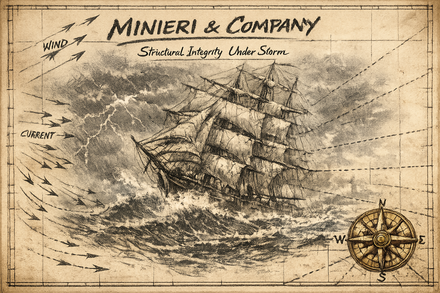
AI-DRIVEN MARKETING STRATEGY

"Helping You Navigate the Digital Storm"

The wind in your sails. The lighthouse on your horizon.
In a world where AI decides what gets seen, we help you structure your website, systems, and messaging so your business is the one that gets chosen.
Minieri & Company LLC
Charleston, South Carolina

AI-Optimized Websites

For businesses whose website isn’t being found, understood, or chosen.

Systems & Automation

For businesses overwhelmed by manual processes, missed leads, or scattered tools.

Marketing Intelligence

For businesses with inconsistent messaging, unclear positioning, or weak conversion.

AI-OPTIMIZED WEBSITES

We design websites that aren’t just visually strong—but structured to be found, understood, and chosen in an AI-driven search environment.

SYSTEMS & AUTOMATION

We install CRM, automation, and operational systems that capture, track, and move leads—so nothing slips through the cracks.

MARKETING INTELLIGENCE

We build your complete messaging system—ads, scripts, positioning, and decision pathways—so your marketing actually works together.

STRATEGIC NAVIGATION

We stay alongside you to interpret what’s happening, adjust direction, and keep your business on course as you grow.

It's fair winds and following seas with Minieri & Company at the helm.

Most businesses are built in pieces—websites, tools, and marketing that don’t truly work together. We bring everything into alignment, creating a system that’s built to be found, understood, and chosen.
BOOK CALL WITH THOMAS

A short, focused call to understand your business, identify what’s working, and map your next steps.

By Thomas Minieri March 26, 2026
There’s a moment most business owners eventually reach. It doesn’t happen at the beginning, when everything is new and full of possibility. It happens later—after the effort, after the investment, after the repetition of trying things that were supposed to work. It sounds something like this: “I’ve done everything I was told to do… so why isn’t this working?” That question doesn’t come from laziness. It comes from experience. Because by the time someone asks it, they’ve already tried the pieces. They’ve run ads. They’ve redesigned their website. They’ve invested in SEO. They’ve posted on social media. They may have even hired agencies, bought courses, or implemented funnels that promised results. And for a moment, each of those things worked—just enough to keep going. But nothing held. That’s where the deeper realization begins. The Core Problem: Why tactics alone don’t fix your marketing Direct answer: Most businesses struggle because they were sold individual tactics instead of a complete system. Without structure and sequence, even good strategies produce inconsistent results. The modern marketing world is built around specialization. Every platform, expert, and agency focuses on a specific function. Ads bring traffic. SEO improves visibility. Websites present information. Funnels guide conversions. Each piece has value. But none of them are designed to stand alone. When you buy marketing this way, you’re not building a system—you’re assembling fragments. And fragments, no matter how well designed, don’t create stability. They create motion. This is why so many businesses feel like they’re doing a lot, yet not getting anywhere. There is activity, but no cohesion. Effort, but no continuity. You were never given something broken. You were given something incomplete. The Shift: What it means to move from pieces to sequence Direct answer: The shift from pieces to sequence means organizing all marketing components into a structured order, where each step has a defined role in guiding a customer from awareness to decision. Sequence is what turns effort into outcome. Without sequence, everything competes. Ads try to sell. Websites try to explain everything at once. Content tries to educate, entertain, and convert simultaneously. Sales conversations carry the burden of resolving confusion that should have been handled earlier. With sequence, each part becomes focused. Attention is created first. Not forced—invited. Then clarity follows. The message sharpens. The noise fades. The prospect begins to understand not just what you do, but why it matters. Trust builds next. Not through persuasion, but through alignment. The experience starts to feel coherent. And finally, the decision happens. Not as a pressured moment, but as a natural resolution of everything that came before. This is the difference most businesses never see. They don’t need more effort. They need the right order. Why disconnected marketing creates inconsistent results Direct answer: Disconnected marketing creates inconsistent results because each tactic operates without alignment, causing breakdowns in messaging, conversion, and buyer understanding. When sequence is missing, friction appears in subtle ways. A potential client clicks an ad, but the website doesn’t match the promise. They read the site, but still don’t fully understand the offer. They book a call, but arrive uncertain and hesitant. The conversation turns into explanation instead of resolution. From the outside, it looks like a conversion problem. But underneath, it’s a sequence problem. Each step failed to prepare the next. So the burden shifts forward, accumulating friction until something breaks. This is why businesses often misdiagnose the issue. They blame the ad, the platform, or the salesperson. But the real issue is structural. The system was never built to support itself. Why this feels different (psychologically) Direct answer: A structured system feels different because it restores clarity, control, and confidence, replacing confusion and guesswork with a clear understanding of how the business operates. There’s a psychological weight that comes with fragmented marketing. It doesn’t just affect performance—it affects perception. You begin to feel like you’re constantly adjusting, constantly reacting, constantly trying to catch up to something just out of reach. Every new strategy carries hope, but also quiet skepticism. Every decision feels heavier than it should. Over time, this creates a subtle but powerful shift: You stop trusting your own judgment. Not completely. But enough that you start leaning on external opinions more than internal clarity. You look for answers outside, because nothing inside feels stable enough to rely on. This is the hidden cost of operating without a system. It erodes authorship. But when the structure is built correctly, that begins to reverse. Clarity replaces confusion. You can see what each part of your business is doing. Control returns. You understand where problems are coming from and how to fix them. Confidence grows. Not from hype, but from visibility. You’re no longer guessing. You’re navigating. And that shift—more than any tactic—is what creates momentum. What changes when you build sequence into your business Direct answer: When sequence is implemented, marketing becomes predictable, conversion improves, and decision-making becomes easier because each part of the system supports the next. Externally, the results become more stable. Leads arrive more consistently. Messaging resonates more clearly. Sales conversations feel more natural and less forced. But internally, something more important happens. The business starts to feel… coherent. Instead of juggling strategies, you’re managing a system. Instead of chasing results, you’re observing patterns. Instead of reacting to problems, you’re anticipating them. And that changes the role you play. You’re no longer the operator trying to make things work. You become the architect who understands why they do. Why this shift matters now more than ever The environment has evolved. Search is no longer just about keywords—it’s about interpretation. AI is shaping how information is discovered and presented. Buyers are forming opinions faster, often before they ever speak to you. In this environment, disconnected tactics don’t just underperform. They become invisible. Because visibility now depends on clarity. And clarity depends on structure. Which means the businesses that win are not the ones doing more marketing. They’re the ones building systems that make their marketing work. Final Thought: You don’t need more pieces If you’ve been trying different strategies and nothing seems to hold, it’s easy to assume the answer is out there somewhere—one more tactic, one more adjustment, one more breakthrough. But the truth is quieter than that. You don’t need more pieces. You need sequence. Because when the structure is right, the pieces you already have start to work in ways they never did before. And that’s when everything begins to change. Ready to See Where Your System Is Breaking Down? If your marketing feels scattered… If your results are inconsistent… Or if you’ve tried multiple strategies and still feel like something is missing… Let’s take a look at it together. Book a 15-minute call , and we’ll unpack: Where your system is breaking down What’s actually causing the inconsistency How to move from pieces to sequence And what the next step should be No pressure. No pitch. Just clarity. Because once you see the sequence… You stop chasing answers—and start building results.
By Thomas Minieri March 26, 2026
If you’ve hired a marketing agency, invested in SEO, experimented with ads, or built funnels—and still feel like your business isn’t stable—you’re not alone. Most business owners don’t lack effort. They lack structure. And that distinction matters more than it seems. Because when something doesn’t work, the natural instinct is to assume you chose the wrong tactic. Maybe the agency wasn’t good enough. Maybe the ads weren’t optimized. Maybe the funnel needed another step. So you adjust, replace, or rebuild… and for a moment, it feels like progress. Then the same pattern returns. Leads come in, then disappear. Revenue rises, then dips. Momentum builds, then quietly collapses. And somewhere in the background, a quieter thought starts to form: Why does nothing seem to hold? That question is the doorway. Because the issue was never the individual strategies. It was the absence of a system connecting them. Why do marketing agencies, SEO, ads, and funnels stop working? Direct answer: Most marketing fails because it is built as disconnected tactics instead of a unified system. Without structure, results are temporary and cannot scale. Most marketing today is sold in pieces. Agencies offer execution. Platforms offer tools. Experts offer tactics. Each one promises improvement within its lane. And to be fair, many of them do produce results—for a while. But none of them are designed to carry the full weight of your business. It’s like assembling parts of a watch and expecting any one gear to tell you the time. The gear isn’t broken. It’s simply incomplete. Time only becomes visible when the entire mechanism is built, aligned, and moving together. That’s why agencies often feel effective at first. A new campaign brings attention. A redesigned website creates engagement. A fresh SEO push increases visibility. For a moment, the system appears to be working. But without a deeper structure underneath, those results have nowhere to land. What is an AI-optimized revenue infrastructure? Direct answer: An AI-optimized revenue infrastructure is a structured marketing system that connects traffic, messaging, and conversion into a single decision path that consistently produces qualified clients. Instead of treating your website, ads, SEO, and content as separate efforts, this approach integrates them into a unified system. Each component has a defined role. Ads create attention and curiosity. Your website creates clarity. Your content builds trust. And your sales process becomes the natural point of decision. This is not about doing more. It’s about connecting what already exists so it finally works together. Why do tactics like ads, SEO, and funnels fail on their own? Direct answer: Individual tactics fail when they are expected to perform the role of an entire system. Each tactic is only one component and cannot generate consistent results without proper sequence and integration. When a business struggles, the instinct is to look for the missing tactic. Better ads. Better SEO. A new funnel. A different platform. But these are not solutions. They are parts. Without a system: Traffic arrives without clarity Interest builds without direction Leads enter without qualification Sales conversations lack structure So even when something works, it doesn’t last. That’s the hidden pattern behind inconsistent results. What is missing from most marketing systems? Direct answer: What’s missing is decision architecture—the structured path that guides a buyer from awareness to understanding to trust to final commitment. Decision architecture ensures that when someone encounters your business, they don’t just see what you do—they understand it, trust it, and feel confident moving forward. Without it, people hesitate. Not because they aren’t interested—but because the path isn’t clear enough to follow. And hesitation is where most marketing breaks. What makes this approach work when others didn’t? Direct answer: This approach works because it builds the underlying system first, ensuring every marketing component has a defined role within a structured decision architecture. Instead of asking, “What should we run?” it asks, “How does this entire system work together?” That shift changes everything. Ads are no longer expected to close. Websites are no longer passive. Content is no longer random. Sales are no longer forced. Each part does its job. And together—they create consistency. What changes when your marketing system is built correctly? Direct answer: When the system is aligned, lead flow becomes consistent, messaging becomes clear, and sales conversations resolve naturally instead of requiring pressure. But the external results are only part of the story. Internally, something deeper shifts. You stop guessing. You stop chasing strategies. You stop relying on conflicting advice. Because you can finally see how your business works. And that restores something most business owners don’t realize they’ve lost: Control. Why this matters now more than ever The environment has changed. Search is shifting toward AI-driven answers. Buyers are making decisions faster. Attention is fragmented across platforms. And traditional, disconnected strategies are becoming less effective over time. This is no longer just a growth problem. It’s a relevance problem. The businesses that adapt are not the ones doing more. They’re the ones built correctly. So why will this work when others didn’t? Because this doesn’t rely on: A single channel A single tactic A single expert It works because it builds the system those things depend on. Where others create activity, this creates alignment. Where others produce short-term results, this produces continuity. And once that system is in place, the question changes. Not “Why isn’t this working?” But “How do I scale what’s already working?” Ready to See What’s Actually Going On in Your Business? If your revenue feels inconsistent… If your marketing feels fragmented… Or if you’ve tried multiple strategies and nothing seems to hold… Let’s take a look at it together. Book a 15-minute call , and we’ll unpack: Where your business is right now What’s actually not working (and why) Whether a structured system is the missing piece And what the next move should be No pressure. No pitch. Just clarity. Because once you can see the system… You can finally start to fix it.
Motion Without Progress: Why Most Marketing Fails—and What Actually Works Now
By Thomas Minieri March 26, 2026
What Does “Motion Without Progress” Mean in Marketing? Motion without progress is when a business is actively investing in marketing—ads, websites, SEO, social media—but still experiences inconsistent leads, unpredictable revenue, and constant rebuilding. It works like this: effort increases, activity expands, but results do not compound. Most business owners assume the problem is execution. In reality, the problem is structural. The Old Marketing Model: Why It Breaks For years, businesses were taught to build marketing in pieces. Websites functioned as digital brochures SEO focused on ranking for keywords Marketing became a mix of ads, social media, and funnels AI was treated as a collection of tools and hacks Agencies delivered activity, reports, and updates At first, this creates momentum. You see traffic spikes. Engagement increases. There is movement. But it doesn’t last. Because none of these elements are designed to work together. The result is predictable: short-term gains followed by collapse. Businesses end up chasing the next tactic instead of fixing the system. This is why so many companies feel stuck—even while doing “everything right.” Why Traditional Marketing Feels So Inconsistent Most marketing fails not because of effort, but because of fragmentation. Here’s what typically happens: Ads drive traffic, but the messaging doesn’t convert Websites look good, but don’t guide decisions SEO brings visibility, but not qualified buyers AI produces content, but without strategic direction Agencies optimize activity, but not outcomes Each piece works independently. But marketing doesn’t scale independently—it scales through coordination. Without a unified structure, results will always fluctuate. The New Model: Marketing as a System Modern marketing requires a different approach. Instead of building isolated tactics, high-performing businesses build systems. At Minieri & Company, that shift looks like this: Website = Revenue Infrastructure Designed to guide, filter, and convert—not just inform SEO = Search + AI Discoverability System Built for both traditional search engines and AI-driven discovery Marketing = Structured Decision Architecture A sequence that moves buyers from awareness to clarity to commitment AI = Integrated Leverage Embedded into the system to enhance performance—not replace strategy You = Translator, Architect, Builder In control of the system instead of dependent on outside activity This is not a small upgrade. It is a complete redefinition of how marketing works. What Happens When You Build It Correctly When marketing is structured as a system, the experience changes. Clarity replaces confusion. Instead of guessing what’s broken, you can see it. Instead of rebuilding constantly, you refine. Instead of chasing leads, you guide decisions. This creates something most businesses never fully achieve: Flow. Clarity → Flow → Conversion → Scale Each step builds on the last. Each component reinforces the system. Growth stops being unpredictable and starts becoming repeatable. Why Most Businesses Haven’t Made This Shift The challenge isn’t a lack of strategies. It’s that the strategy ecosystem itself is fragmented. Business owners are exposed to: Conflicting advice Isolated tactics Tools without context Experts without accountability So they do what seems logical: stack more on top. But stacking tactics without structure only increases complexity. The breakthrough comes when you stop asking, “What should I try next?” And start asking, “What system am I actually building?” The Bottom Line If your marketing feels inconsistent, it’s not because you haven’t tried hard enough. It’s because the model you’ve been given was never designed to scale. The businesses that win today are not the ones doing more. They are the ones building correctly—structure first, sequence second, leverage last. And once that foundation is in place, everything else starts working the way it was supposed to. If you’re seeing pieces of this in your business—if leads are inconsistent, marketing feels fragmented, or you’re not sure what’s actually broken—it’s worth getting clear on it. I offer a 15-minute strategy call where we’ll look at your current system, identify where things are breaking down, and determine whether Minieri & Company is the right fit to help you rebuild it correctly. If it makes sense, I’ll walk you through exactly how we would move forward. No pressure. Just clarity. Book a time, and let’s take a look together.